Sunday, January 1, 2012

Tea, Tea, and more Tea

I'm told that from a very early age, I adored tea. I never grew out of my penchant for having tea parties, and multiple birthday parties became tea parties, and tea-related gifts came to be my favorites to receive. To this day I'm still a tea lover, and as the weather has started to become cooler, I'm gearing up for another lovely tea-filled winter!


Many people say they don't "get" tea, and the appeal is kind of hard to explain. My love of it is multi-dimensional. I first and foremost love the tastes of different teas: the intricacies of different types and flavors. Tea is also my favorite means of relaxation, whether I need a cup as I'm working or as I soak in the bathtub. I also like the precision of tea making. To make tea well, the amount of tea, temperature of the water, steep time, and more need to be monitored carefully, and I like the different details and ritual that goes along with making it. Tea is also beautiful in and of itself, and I love watching leaves unfold as they steep, and the color of the infusion after it has steeped. The beauty also comes in the form of beautiful teapots and containers that hold tea! 


I'm sure that I'll add more posts about tea later, but today I want to show some of my favorite teas and accessories. I wouldn't be able to call myself a real tea lover if I didn't use loose, whole leaf tea instead of tea bags (come to think of it, I don't remember the last time I used ground up, bagged tea!). Once I discovered loose tea, I never looked back: the flavors are so much deeper and complex in loose tea, as opposed to the ground tea that now tastes like metal to me. 


Let me first post a chart from Teavana that has proven helpful in my tea making adventures. It lists the type of tea, along with the amount of leaves to use in 8 ounces of water. The last two columns show the temperature that the water should be, and then the steeping time. Many people just thrown a tea bag into hot water and leave it there as they drink it, but it really should be removed after the time listed to avoid a bitter taste. 


By the way, I love Teavana. Where I live, at least, this is the best place to find high-quality tea. I'd love to hear about tea stores you love too! Teavana can be expensive, but good teas are bound to be expensive since the best parts of the tea plant are used.


As I said above, one of the things I enjoy about tea is storing it. Tea needs to be kept in an airtight container, preferably a tin one, away from heat and light. Teavana has some beautiful tins--I have the one pictured second from the right, which I keep some green tea in, and it's fun to look at and take out in my tea-making process.


I adore my elephant teapot which I found at World Market (one of my favorite stores--need to write about that too!). It's a very stylish way to serve tea. You don't have room for a full infuser basket, so you might need a tea ball, but it's still a wonderful pot.

World Market is also a great place to find tea if you're weaning yourself off of the bad ground-up tea for a reasonable price. If you're looking for a great-tasting green tea for a very good price, try this green tea--it's not completely full leaf but it's still much better than the ground-up stuff. It's $6 for 15 tea bags, and you can use the bags more than once if you do it properly. The bags are also biodegradable, and I love tossing them in my compost bin when I finish, knowing it might become this summer's tomatoes!

I'll add more tea wisdom later! 

Friday, December 23, 2011

Personalized Coasters: Easy, Last-Minute Gift!


If you're like me and you prefer DIY gifts over meaningless store-bought items, this easy tutorial is for you. The idea actually came to me (or maybe I remembered it from something else; I'm sure I didn't invent this idea!) when I was trying to think of a gift idea for my father for Christmas. I'll explain more later...


One of my  best friends was recently accepted to Kenyon College in Ohio and is going next year! To congratulate her and help her rev up her school spirit (go Owls!), I wanted to make her a school-spirited coaster.


You can make these coasters with virtually any print-out, and the gist of the DIY is Mod-Podging a printed image onto a basic ceramic tile. I found square tiles (4.25 in x 4.25 in) for $0.82 a piece at Home Depot, so this DIY is wallet-friendly too. Then, the only other supplies you need are:
-Mod Podge (which any crafter probably already has!)
-a basic paintbrush


-access to a computer or printer
-felt and glue gun (optional)


First, select the image of what you will put on your coaster. I just used Google to find an image of the Kenyon logo, and paste into Word to size and print. 

Next, print your image. Plain white paper is fine, but I like to use business stationery, which is a bit thinner and easier to paint on. Check the size of your image to make sure it fits the way you want on your tile. Then, cut it out! 
 Then you can start your first layer of Mod Podge on the entire face of the tile. Make it as smooth as possible, but it doesn't have to be perfect. Just don't use huge amounts, or the paper will become too soggy.
  Now you can press on your cut-out image. Smooth it across the tile to avoid air bubbles collecting underneath it. You'll need to do this periodically, especially as you add on extra layers of Mod Podge. 
 Give extra care to painting the edges of the image neatly onto the tile. As you paint over the image, colors might bleed a bit, so don't move the brush back and forth a lot over the image on the first coat of Mod Podge. This stuff dries rather quickly, so in 10-15 minutes, you can add on another coat and the image won't bleed as much. As it dries those first few times, remember to smooth out air bubbles and lacquer the edges of the imdage. You can do as many coats as you want. I like to do four or so--since we're making a coaster, we want it to hold up to water, and that many coats will do fine.

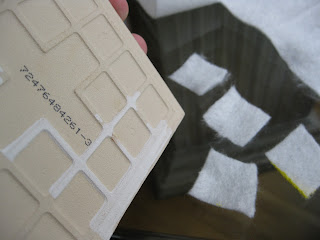
 The bottom of the tiles, at least the ones I bought, are pretty rough in texture. Since the coasters are supposed to be protecting the surface they cover, especially wood, we'll make sure the coaster is smooth on the bottom with some felt. You can buy adhesive felt pads at the hardware store (the kind you put on drawers and things so they don't bang when they close), or you can be thrifty and use some extra felt you might have lying around! I cut out four small squares of white felt and hot-glued them near the corners of the tile. Now it can't scratch the table!

Now you're done! 

There are so many possibilities of images you could put on the tiles. As I said at the beginning, I made a set for my father for Christmas, and I used old maps from places that were meaningful to him, as well as some pages from an old dictionary (I found the page that contained the word "father" and underlined it so it's noticeable) as well as a page from Paradise Lost. Need some more ideas?
-pages from old books
-family pictures
-logos of companies or schools
-a printed out quote
-nature images, like birds and botanicals
-a large letter for the initial of the recipient
-old sheet music
-a set of holiday-themed tiles, like decorative eggs for Easter, different reindeer for Christmas, etc.
-single words in different languages
-geometric designs
-comic strips

Have fun making your coaster!
-Clandestine


Saturday, October 22, 2011

Creative DIY's for the Creative Homemaker!

DIY: Yet More Paint Chip Art
Paint Chip art! Create murals, like the DIYer above. I used paint chips for bookmarks and covered my planner in a gradient pattern of chips and put laminating paper on top!


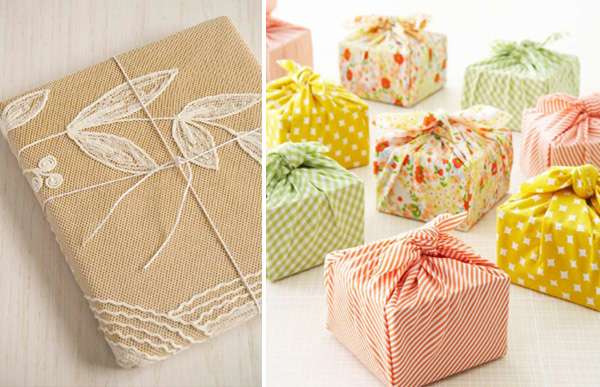
Cute wrapping ideas! Try wrapping in leftover lace and other fabrics.

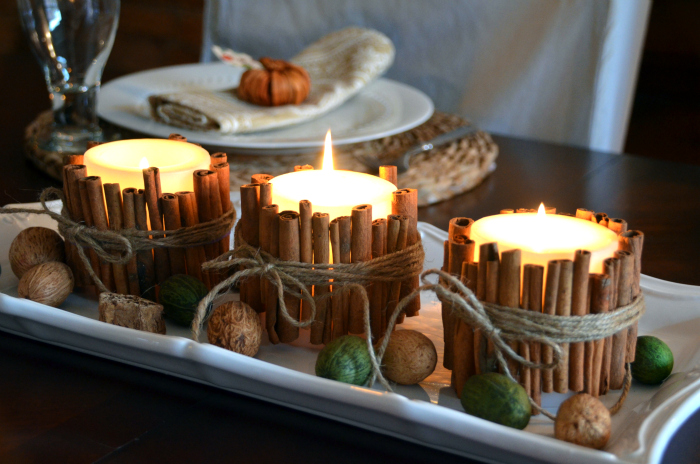
Cinnamon Stick candles! Especially perfect for this season. :)

Sunday, July 3, 2011

The following is a supplement question from Williams College:
Imagine looking through a window at any environment that is particularly significant to you. Reflect on the scene, paying close attention to the relation between what you are seeing and why it is meaningful to you. Please limit your statement to 300 words.
This response certainly won't fit into 300 words when I free-write it. What an obscure question. I don't feel like I have that many places that are significant to me aside from my own house which I've lived in for my entire life. I really want to say that I'm looking across a landscape or scene that is truly sustainable. I guess I might say that I'm looking across a farmer's market. It is certainly a scene where I feel hopeful. I go through my days with constant concern about the environment and am bothered by every piece of trash that I throw away which will go to a landfill and by every piece of food in my kitchen, wondering how far it came to sit on my table and what impact it had on the people that had to grow it and transport it simply for my benefit. But at the farmer's market I'm so glad to see other people patronizing it, and I love helping the local farmers in any way I can. I find it quite comforting to see people going from booth to booth talking to each other, discussing the crops with the farmers, and coming home with fresh produce, bread, and meat. Going to the supermarket is surprisingly impersonal compared to the hustle and bustle of the farmer's market where people seem happy to be there and talk to their neighbors. The market makes me feel closer to nature--when we go to the supermarket, most fruits are available year round, but very few crops actually grow year-round. At the market I know that I realize (and I hope that others do too) that we have to wait until summer for most of our vegetables and that lettuce grows in the cooler seasons. Everything tastes cleaner when I buy it from the market-- I don't worry as much about harmful pesticides, all the food is fresher since it's come from a shorter distance, and it's grown in more natural conditions. In all of my work in environmentalism, I'm often bombarded with all of the problems of ecological problems, but it isn't very often that I get to see solutions to these problems. The farmer's market lets me lay eyes on solutions that humans can come up with to fix our problems. That was a little more than 300 words. :)

Monday, June 27, 2011

How has college admissions made you rethink yourself?

The answer to this question will surely change over the next year as I deal with denials and acceptances and everything in between while applying to college, but I should probably write on this question now too:

Wake Forest is rethinking admissions. How has college admissions made you rethink yourself?
What an important question to answer. All schools should be rethinking admissions--this process has gotten entirely out of control and I honestly predict that one of these years it will blow up in our faces. The process is too competitive, too much about numbers, too politicized. The process has only made me feel worse about myself, even though in general I'm a very confident person, and made me cynical, unfortunately.

I suppose the thing that has most disappointed me (but also made me understand myself better) about the process is the resume-building. It feels like the only reason so many teens are involved in clubs, sports, and community service is for the purpose of saying, "look, College, I did this and it's impressive!" I find this nauseating...it's just a form of groveling and playing their game. It doesn't feel genuine.

I participate in all kinds of activities on campus, and sometimes someone will ask me, "do you just do all of those things to say that you do them on your college apps?" The answer always no. I genuinely like everything that I take part in and have never signed up for something just because it "looks" good. I've seen plenty of people who aren't in the same boat, though. At one point sophomore year, many students were submitting applications to a leadership group, myself included, I was really excited about the group and really wanted to be a part of it. In one of my classes, a girl asked another girl if she was applying for the group. "Yeah, I have to get into college somehow," was the response. What a backwards thought, as all I could think. Why should that girl get to take up the spot in the group when someone else actually wants to be in it?

 I've realized about myself, though, that this genuineness is extremely important to me. It's essentially honesty. I understand that I will never be the type to cheat to get ahead or change myself to please someone else. 

Since freshman year there has been this ubiquitous, intangible being called College that we were all terrified of.  And it seems that all we've been doing, especially in the past year, was trying to please College, whether that be with test scores, grades, extracurricular activities, or even just a sob story in a college essay. I haven't like being asked to cater to College's needs in my high school careers. What about what I want? What about pleasing myself first? What about enjoying my high school years instead of having to think about the four years that will follow?

There have been several points in the last few years when I've had to pause and ask myself what I want and follow that guideline instead of serving College whatever it wants on a silver platter. For example, when my last test scores came and were good but not perfect, I had to really ask myself if I wanted to keep trying for a perfect score. I had to make myself stop. I wanted to stop so much. Why would I pour my efforts into showing that I could master this one test?

And on the note of test scores, I should be grateful that there are two standardized tests that all colleges will accept, as I was definitely better suited for the ACT. But I feel as if there should be a few more tests, each measuring different kinds of intelligences. Some people are geared toward the SAT and some towards the ACT, but some need a different kind of test to show what kind of student they are.

The process has certainly made me rethink what I want out of my life. I now have a pretty concrete understanding that in my career, I want to be having a positive impact in the world, hopefully by doing something with conservation, and I want to be producing something like a publication. I value the written word and its ability to have an impact, and I hope that in a magazine I could spread the world about environmentalism as well as stretch my creative muscles in graphic design, breathing in the aesthetic aspects of publication production.

On Empathy, Courage, and Action

Princeton University's large essay on their application has a question which says,
Using the following quotation from “The Moral Obligations of Living in a Democratic Society” as a starting point, tell us about an event or experience that helped you define one of your values or changed how you approach the world. “Empathy is not simply a matter of trying to imagine what others are going through, but having the will to muster enough courage to do something about it. In a way, empathy is predicated upon hope.” Cornel West, Class of 1943 University Professor in the Center for African American Studies, Princeton University
I've always felt like an extremely empathetic person. When I hear of the terrible things that happen to people everyday I often feel absolutely sick to my stomach imagining the pain that they must be in. But in the cause which is most important to me, environmentalism, my empathetic feelings are shifted more towards the earth itself and the animals that inhabit it. I can use the classic example of polar bears--the precise reason why the World Wildlife Fund and other organizations use them and show you how the mothers can't feed their babies on the decreasing amount of ice is to make you empathize with them and donate. But my most clear, life-changing moment of both empathy and determination came all the way back in the fourth grade.

I'm not completely sure why we did this, but at one point in fourth grade we watched a few videos about deforestation and landfills. I have clear snapshot memories of the landfill video, and it had a huge eye-opening effect. Like most of the other children I had never really considered where my trash went once I threw it away. Surely that was the end of the line; the trash was gone, so why would I think about it? The images of millions of people's garbage covering so much land horrified me, and I felt that deep abjection and aphoria where my entire paradigm of the world shifted. It's hard to express exactly "who" I was having empathy for unless the Earth is a justifiable answer. Over the last few years I have understood more and more that the earth is the being that we inhabit that can't speak for itself, and I've begun to have more and more empathy for it as if it were a person just like you and me.

I could have stopped there, that day in fourth grade, and let the horrors stop. Ignorance is bliss, as they tend to say. But I think my greatest show of courage that resulted from the empathy I had with the Earth was exposing myself to more information that would shock me. I'm constantly searching for more documentaries about everything that we're doing wrong to our Earth, reading more about the science behind climate change, investigating more and more into systems, like waste disposal, that are commonplace but are problematic behind the scenes. Simply searching out more information is the greatest action I think I could have taken. From there, I'm always looking for ways to fix things, starting with myself of course, and spreading the message and ideas to my school community through the Campus Conservation Corps (CCC). Some people take up a cause after being inspired by something, but the inspiration often stems from horror of some kind. I think there's always a day of abjection in our lives when the world is no longer such a wonderful place and we're forced to not only recognized but often cope with what is wrong. The courage step comes between the recognition and the coping, almost just like the quote said. Ever since that video, I have become uber-conscious of my effect on this planet, positive and negative. The Earth needs just as much empathy as any other being, if not more, considering that it is the only being that we all have in common.

Saturday, June 18, 2011

Top 10 Myths About Introverts

I absolutely couldn't help but reblog this. I consider myself an introvert even though I have a few extroverted qualities, and I especially relate to the corrections of Myths 5 and 6.


TOP TEN MYTHS ABOUT INTROVERTS

Myth #1 – Introverts don’t like to talk.
This is not true. Introverts just don’t talk unless they have something to say. They hate small talk. Get an introvert talking about something they are interested in, and they won’t shut up for days.
Myth #2 – Introverts are shy.
Shyness has nothing to do with being an Introvert. Introverts are not necessarily afraid of people. What they need is a reason to interact. They don’t interact for the sake of interacting. If you want to talk to an Introvert, just start talking. Don’t worry about being polite.
Myth #3 – Introverts are rude.
Introverts often don’t see a reason for beating around the bush with social pleasantries. They want everyone to just be real and honest. Unfortunately, this is not acceptable in most settings, so Introverts can feel a lot of pressure to fit in, which they find exhausting.
Myth #4 – Introverts don’t like people.
On the contrary, Introverts intensely value the few friends they have. They can count their close friends on one hand. If you are lucky enough for an introvert to consider you a friend, you probably have a loyal ally for life. Once you have earned their respect as being a person of substance, you’re in.
Myth #5 – Introverts don’t like to go out in public.
Nonsense. Introverts just don’t like to go out in public FOR AS LONG. They also like to avoid the complications that are involved in public activities. They take in data and experiences very quickly, and as a result, don’t need to be there for long to “get it.” They’re ready to go home, recharge, and process it all. In fact, recharging is absolutely crucial for Introverts.
Myth #6 – Introverts always want to be alone.
Introverts are perfectly comfortable with their own thoughts. They think a lot. They daydream. They like to have problems to work on, puzzles to solve. But they can also get incredibly lonely if they don’t have anyone to share their discoveries with. They crave an authentic and sincere connection with ONE PERSON at a time.
Myth #7 – Introverts are weird.
Introverts are often individualists. They don’t follow the crowd. They’d prefer to be valued for their novel ways of living. They think for themselves and because of that, they often challenge the norm. They don’t make most decisions based on what is popular or trendy.
Myth #8 – Introverts are aloof nerds.
Introverts are people who primarily look inward, paying close attention to their thoughts and emotions. It’s not that they are incapable of paying attention to what is going on around them, it’s just that their inner world is much more stimulating and rewarding to them.
Myth #9 – Introverts don’t know how to relax and have fun.
Introverts typically relax at home or in nature, not in busy public places. Introverts are not thrill seekers and adrenaline junkies. If there is too much talking and noise going on, they shut down. Their brains are too sensitive to the neurotransmitter called Dopamine. Introverts and Extroverts have different dominant neuro-pathways. Just look it up.
Myth #10 – Introverts can fix themselves and become Extroverts.
Introverts cannot “fix themselves” and deserve respect for their natural temperament and contributions to the human race. In fact, one study (Silverman, 1986) showed that the percentage of Introverts increases with IQ.